
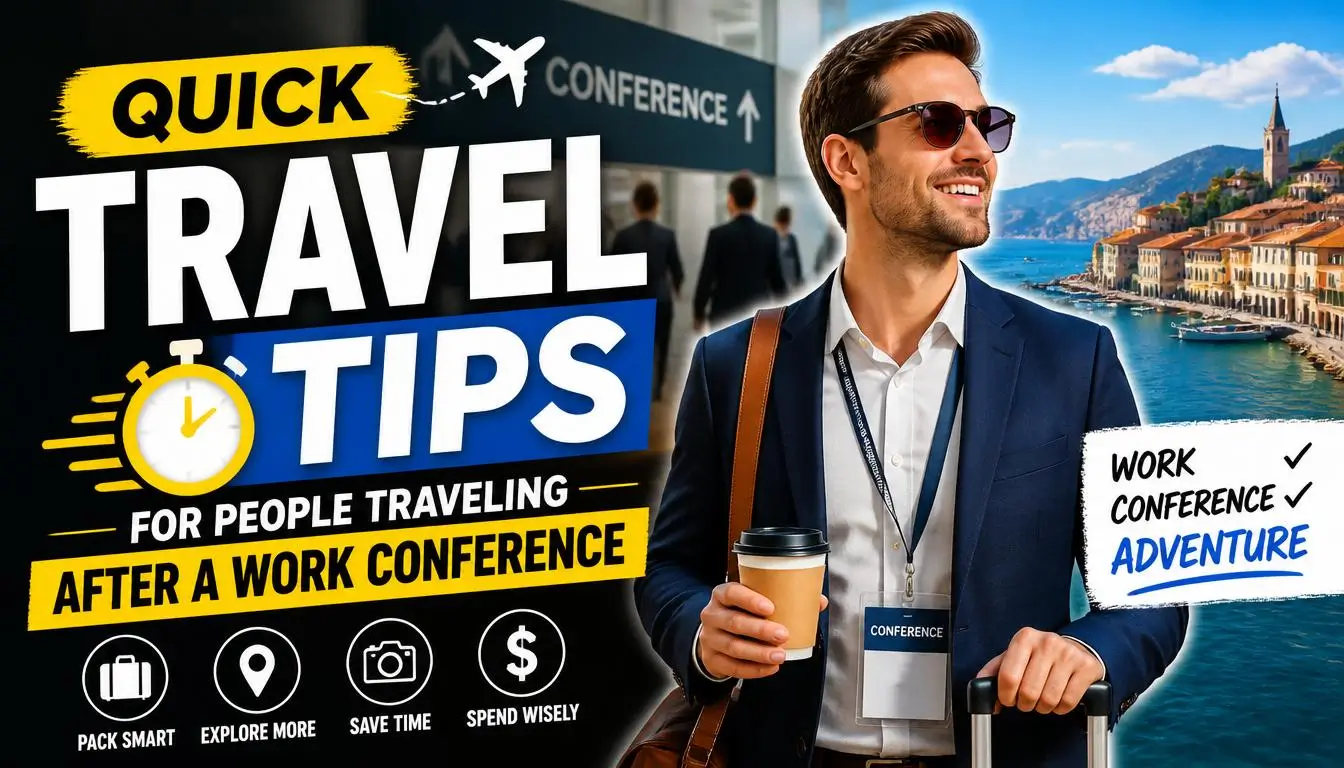
Nobody writes a guide specifically for the travel tips people need when traveling straight after a work conference, which is a gap worth filling because the post-conference trip is its own specific travel format with its own specific challenges. You’re not starting a vacation fresh and rested. You’re transitioning out of two or three days of sustained professional performance, artificial lighting, catered food that has done nothing for your energy levels, hundreds of handshakes, and a schedule that someone else controlled entirely. Your brain is simultaneously overstimulated and exhausted in a combination that feels nothing like regular tiredness, and you’re trying to pivot from that state directly into enjoying yourself somewhere new. The pivot is possible. It just requires a specific approach.
Understand What Post-Conference Exhaustion Actually Is
Before any practical tip lands usefully, understanding what’s happening physiologically after a heavy conference makes the strategies make more sense rather than feeling like arbitrary advice.
Conference exhaustion is not standard physical tiredness. It’s a specific combination of social overstimulation, decision fatigue, disrupted sleep from unfamiliar hotel beds and late networking events, disrupted nutrition from conference catering, and the sustained cognitive load of professional performance across multiple days. Your nervous system has been running at a heightened social alertness level for the entire conference duration, processing enormous amounts of new information, managing professional impression and relationship building simultaneously, and doing all of this on sleep that was probably less restful than your normal routine produces. The result is a brain that feels simultaneously wired and depleted, which is a genuinely uncomfortable state to try to pivot from into enthusiastic tourism. Knowing this is physiological rather than a weakness of character changes how you plan the transition, because you stop trying to push through it on willpower and start designing around it instead.
1. Pack Two Separate Bags From the Start
The single most effective logistical decision for a post-conference personal trip is one that needs to be made before you leave home rather than at the conference hotel front desk when you’re already tired.
Pack a dedicated conference bag containing everything professional you need for the work portion of the trip: business clothes, laptop, presentation materials, networking supplies, business cards, and anything else the conference requires. Pack a separate personal travel bag containing everything you need for the leisure portion: casual clothes, personal toiletry kit, travel reading, and whatever makes a personal trip feel like yours rather than an extension of work. Keep these bags completely separate from the beginning. When the conference ends, your conference bag goes into storage, gets shipped home, or gets checked for the flight home while your personal bag becomes your only active luggage. The physical act of closing the conference bag and switching to the personal bag serves as a genuine psychological transition marker that makes the pivot from work mode to travel mode faster and more complete than carrying everything mixed together in one suitcase.
2. Build a Transition Buffer Between Conference End and Travel Start
Jumping directly from the conference closing session into a taxi to the next destination with no buffer time is how post-conference travel starts badly and stays that way for the first day.
Build a minimum of two to three hours of buffer time between the formal conference end and the start of your personal travel. Use this time to change out of professional clothing into something comfortable and personal, eat a proper meal that isn’t conference catering, decompress quietly without professional social obligation, and mentally close the conference chapter before opening the travel one. If the conference and your personal destination are in the same city, this buffer might be a long lunch alone or with one person you genuinely like rather than the full conference group. If you’re traveling to a different city immediately, the buffer might be the airport itself, specifically the airport lounge where the transition from conference mode to travel mode can happen in a quieter, more comfortable environment than a crowded gate. Priority Pass membership provides lounge access at most major airports globally for around $100 per year and pays for itself within the first two or three post-conference airport transitions.
3. Choose Your Post-Conference Destination Based on Energy Requirements
The destination that sounds most appealing in the abstract may not be the destination that serves you well when you’re arriving with a depleted post-conference nervous system, and choosing based on what you actually need rather than what sounds impressive is how post-conference trips become genuinely restorative rather than adding another layer of exhaustion.
High-stimulus city destinations with packed attraction schedules, complex transit systems, and aggressive tourism infrastructure require cognitive and social resources that the post-conference traveler has usually just spent. Quieter destinations with lower logistical complexity serve the post-conference traveler significantly better for the first day or two of the transition period. A coastal town within train distance of the conference city. A smaller city with a walkable center and no must-see list that creates obligation. A countryside retreat that requires no navigation more complex than following a single road. The rule that works consistently: match the complexity of your destination to approximately half the energy level you think you’ll have after the conference, because post-conference energy is reliably lower than pre-conference estimates suggest it will be.
4. Give Yourself Permission to Do Nothing on Day One
Every post-conference traveler makes the same mistake at least once: arriving at their personal destination immediately trying to maximize the experience by doing everything they had planned, which produces a day that feels nothing like the travel experience they anticipated because they’re doing it while cognitively and emotionally depleted.
Day one of a post-conference personal trip should have almost nothing scheduled. Arrive at accommodation. Change clothes. Eat a proper meal at a pace that doesn’t exist at conference catering. Walk around the immediate area without a destination. Sit somewhere pleasant and do nothing useful for at least an hour. Sleep at whatever time your body requests rather than the time your itinerary suggests. This sounds like wasted travel time from the outside and feels like exactly the right use of the first day in practice. The travelers who genuinely enjoy their post-conference trips are almost always the ones who gave themselves day one for recovery and found that day two arrived with significantly more genuine energy and enthusiasm than day one would have delivered if packed with activities.
5. Eat a Real Meal as Your First Post-Conference Act
Conference catering is nutritionally mediocre in a specific and consistent way. The combination of heavy lunch buffets, constant snack availability that produces irregular eating patterns, alcohol at networking events, and coffee consumed far beyond the point of useful alertness produces a nutritional state by conference end that contributes meaningfully to post-conference exhaustion.
Your first post-conference meal should be a real, sit-down meal that you chose rather than one that was chosen for you, eaten at a pace that allows you to taste it, ideally containing vegetables and protein rather than the carbohydrate-heavy conference buffet fare your body has been running on. This meal serves both nutritional and psychological purposes simultaneously. It is the first thing in the trip that is entirely about what you want rather than what the conference required. Research one specific restaurant near your accommodation that serves the kind of food your body is actually craving rather than what seemed like a good idea three weeks ago when you were planning the trip. Book a reservation for the first evening at a table for one or for your travel companion, and treat it as the genuine start of the personal portion of the trip rather than an afterthought squeezed in between arrival logistics.
6. Handle Conference Follow-Up Emails Before You Leave the Conference City
The mental background noise of knowing that conference follow-up emails are sitting unwritten while you try to enjoy a personal trip is one of the most reliable ways to prevent genuine mental disengagement from work during the travel portion.
Before you leave the conference city, spend ninety minutes in a café or hotel lobby writing every follow-up email that you know needs to happen in the next 48 hours. Not every email. Not a comprehensive networking follow-up campaign. The specific emails that your brain will keep composing in the background if you don’t write them now. The thank-you to the speaker whose session changed how you think about something. The follow-up to the person whose card you took with a genuine intention of continuing the conversation. The response to the colleague who asked you to send them that resource. Getting these written before you leave means your brain stops carrying them as open loops during the personal trip, which produces a meaningfully cleaner mental state for the travel experience that follows. Schedule them to send over the following two days rather than sending everything in a batch that arrives the same afternoon if the timing feels socially aggressive.
7. Change Everything About Your Physical Presentation
This tip sounds superficial and works profoundly. The physical cues that signal professional mode to your nervous system, specifically the clothes, the conference badge, the laptop bag on your shoulder, and the business card holder in your pocket, maintain a state of professional alertness that actively resists the transition into personal travel mode.
When the conference ends, change every physical signal immediately. Different clothes, specifically something casual and personally expressive rather than professionally neutral. Leave the laptop in the hotel safe or conference bag if you’re not traveling with it for the personal portion. Remove the conference badge and put it away entirely rather than leaving it around your neck out of habit. Put on shoes you wouldn’t wear to a meeting. The physical change signals to your nervous system that the context has shifted in a concrete and embodied way that the mental decision to be “on vacation now” doesn’t produce by itself. This transition is particularly important for people whose professional identity and personal identity are closely intertwined, because the physical signals are sometimes the only concrete way to distinguish between modes when the psychological switch is slow to engage.
8. Avoid Scheduling Any Work Calls During the Personal Portion
This boundary requires setting explicitly before the trip rather than negotiating it reactively in the moment when someone proposes a call during your personal travel window.
Tell your team, your manager, and anyone else who might reasonably expect your availability that you will be unavailable for calls from a specific date through a specific date. Do this before you leave for the conference, not after it ends, because doing it retroactively during the personal trip puts you in the position of declining requests that are already on the calendar rather than preventing them from being scheduled in the first place. Set an out-of-office message that covers the personal travel period explicitly. Most professional cultures accept a simple “I’m traveling and will respond to non-urgent messages from [date]” without requiring explanation or justification. The one exception worth building in: a genuine emergency contact method for situations that genuinely cannot wait. Providing that option while removing yourself from routine availability is the professional middle ground that works in most workplace cultures.
9. Use Public Transport for the Personal Trip Even If You Used a Car Service for the Conference
Conference logistics often involve car services, airport transfers, and shuttles that move you efficiently but passively through the city in a way that produces almost no genuine orientation to the place you’re in. Switching to public transport for the personal portion of the trip changes your relationship with the destination immediately and usually saves meaningful money simultaneously.
A city’s public transport system is where the actual texture of daily life in that place is most visible. The subway car at 6pm in Tokyo, the tram through the center of Lisbon, the bus along the Chicago lakefront, the metro in Paris, all of these provide ground-level access to how a city actually moves that an Uber through the same streets doesn’t. Beyond the experiential argument, the cost difference between conference transport modes and local public transport modes is often significant. Transit App covers most major cities globally with real-time routing and works offline with downloaded maps. Downloading it before the personal portion of the trip begins means switching to public transport requires no research in the moment, just opening an app you’ve already set up.
10. Protect Your Sleep for the Entire Personal Trip Duration
Conference sleep is reliably poor. Late networking events push bedtime later than normal. Hotel room beds that aren’t your own, unfamiliar sounds, and the anxiety of professional performance produce lighter and less restorative sleep than your home routine. By conference end, most attendees are carrying a meaningful sleep deficit that the personal trip either compounds or resolves depending on how deliberately sleep is managed during it.
Protect sleep as actively as you protect the activity schedule during the personal trip. This means a consistent bedtime regardless of what’s happening in the destination, because consistently late nights add to an existing deficit rather than treating it like a fresh start. It means a hotel room that’s genuinely dark, using the travel blackout tape and binder clip curtain seal method if the room’s curtains are inadequate. It means a white noise solution, the LectroFan Micro2 packs small enough for any luggage, that buffers the unfamiliar sounds of a new city that produce lighter sleep than your home environment. It means not setting an alarm for any morning where there is no genuine time commitment, because the post-conference traveler who wakes naturally after nine hours has a demonstrably better day than the one who set a 7am alarm to maximize daylight hours and arrives at the first attraction exhausted.
Frequently Asked Questions
How do you mentally transition from conference mode to personal travel mode?
The most effective transitions are physical and concrete rather than purely mental. Change clothes, switch bags, eat a real meal, and give yourself a buffer period of two to three hours with no scheduled obligations between the conference end and the start of active tourism. Writing all pending conference follow-up emails before leaving the conference city removes the most persistent mental background noise that prevents genuine disengagement from work mode.
Is it worth adding personal travel after a conference even if you’re exhausted?
Yes, with the right destination choice and realistic expectations for day one. The exhaustion is real but typically resolves significantly within 24 to 36 hours of the conference ending when sleep, proper food, and low-obligation time are allowed to do their work. The travelers who regret adding personal travel after conferences are almost always the ones who scheduled the personal portion as densely as a normal vacation rather than accounting for the recovery period the first day requires.
How do you handle luggage when transitioning from conference to personal travel?
The most effective solution is the two-bag system packed before departure. A conference bag containing professional items and a personal bag containing leisure items travel together but are used separately during their respective portions of the trip. At conference end, the conference bag can be checked for a flight home, shipped home via FedEx or UPS from the conference hotel, or stored at the hotel’s luggage storage if you’re remaining in the same city. Traveling with only your personal bag for the leisure portion removes both the physical weight and the psychological weight of carrying conference materials through a personal trip.
What’s the best type of destination for post-conference travel?
Lower-complexity destinations with walkable centers, minimal navigation requirements, and no must-see obligation lists serve post-conference travelers consistently better than high-stimulus city destinations during the transition period. Coastal towns, smaller cities, and countryside destinations adjacent to conference cities are ideal for the first post-conference day or two, with more ambitious destinations becoming genuinely enjoyable once the initial recovery period has passed.
How do you avoid work creeping into personal post-conference travel time?
Set explicit availability boundaries with your team before the conference begins rather than negotiating them reactively during the personal travel period. Use an out-of-office message for the personal travel window. Front-load all urgent conference follow-up before leaving the conference city so your brain doesn’t carry those open loops into the personal trip. Designate one specific check-in time per day, fifteen minutes maximum, for genuine emergencies rather than being either fully on-call or completely unreachable, which produces a middle ground most professional cultures can accept without friction.
Conclusion
The post-conference personal trip is one of the more underrated travel formats available to anyone whose work involves regular conference attendance, and it works beautifully when the first day is protected for recovery rather than packed for productivity. The city will still be there on day two when you actually have the energy to experience it properly. Where are you thinking of adding a few personal days after your next conference?